

Smart Factory

Smart Factory Workforce Management Software

Manage the entire workforce effortlessly with our automated cloud-based workforce management solution. Get real-time insights and streamline human capital from deployment and shift scheduling to time-tracking.

Enhance productivity with Workforce Management Solution

Enhance productivity with Smart Factory MOM’s video

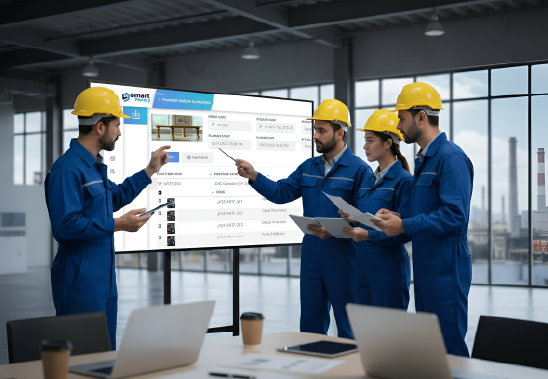
Gain complete control of workforce activities with the Smart Factory workforce scheduling software. It helps maximize the efficiency of your workforce and ensure that you are making the most of your resources, allowing manufacturers to automate control and monitoring, review, and map labor requirements based on availability, skills, performance, breaks, and shifts.

The platform has access and assignment rules defined to control user access, streamline machine orders, and automate task assignments based on defined skills and availability. Admin can analyze end-to-end workforce flow to analyze and optimize maximum output generation. Equipping the managers with the tools to quickly fill the efficiency gaps, to plan and manage resources effectively, and to ensure the right people are working on the right product and at the right time.

Optimize Workforce with Our Workforce Management Module

Operating Method Sheets

Operating Method Sheets

Fully customizable electronic instruction sheets to assist with high-quality production. This includes versioning & ECN control, electronic chronometers and timers to record time, multimedia support, real-time data tracking, and quality assurance with validations and flows based on answers.

Reports and analysis

Reports and analysis

The Reports & Analytics module delivers a comprehensive view of workforce and resource performance across shifts, departments, and operations. Getting the data through a system or ERP is the first step, and then analyzing the data in real-time is the next step.

eLearning

eLearning

eLearning module will equip your employees with a consistent learning system. Employees get customized training routes for their personnel profiles, allowing employees to learn at their pace. This leads to better comprehension and retention of concepts for employees.

Key Features of Workforce Management System

Attendance Monitoring

Tracking the clock in/out timing of the employees and monitoring their attendance and productivity on the shop floor.

Master Data

This includes end-to-end detail and activity of the employee, including employee ID, position, skills, break log, shifts, etc.

Reports

Check performance reports and e-learning assessment reports and monitor how well a worker is progressing and being efficient for the team.

Shift Management

Effective shift planning, balance workload exposure to different shifts. Infinite shift types definition based on calendars and status.

Skills Development

Employee skills recorded within the system are based on expertise level to get the best available resource for the specific operation.

Break & Activity Tracking

Keeping records of employee activities on the production floor, tracking break timings and availability, etc.

Integrated Employee Records

The system can be integrated with external systems like ERP or CRM and synced with employee records.

Role-Based Scheduling

Helps to optimize staffing levels and workload distribution and maintain continuous production coverage.

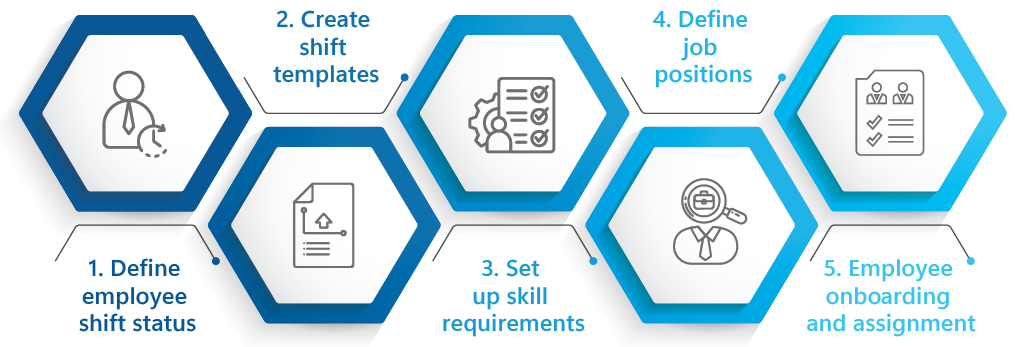
End-to-End Employee Setup & Workforce Management Flow

End-to-End Employee Setup & Workforce Management Software Flow Diagram

Key Benefits of Smart Factory Workforce Management Software?

Optimize and simplify complex schedules, laws, and workforce tasks with intelligent automation. Save hours, cut costs, and keep your production running at peak efficiency with a robust workforce management solution.

Compliance Monitoring

Compliance Monitoring

Automate and monitor the compliance process to prevent legal risks and penalties. Adhere to policies, compliance, labor laws, and regulations. Ensure that accurate records are maintained for workforce accountability.

Optimized Labor Costs

Optimized Labor Costs

Control labor costs by minimizing inefficiencies, unplanned overtime, and absenteeism. Optimize workforce planning and scheduling with a workforce management system to ensure accurate resource allocation.

Improved Efficiency and Productivity

Improved Efficiency and Productivity

Real-time continuous performance monitoring helps to ensure that staff meet productivity targets. Optimize scheduling and automate tasks with a workforce management tool to achieve higher productivity and boost efficiency.
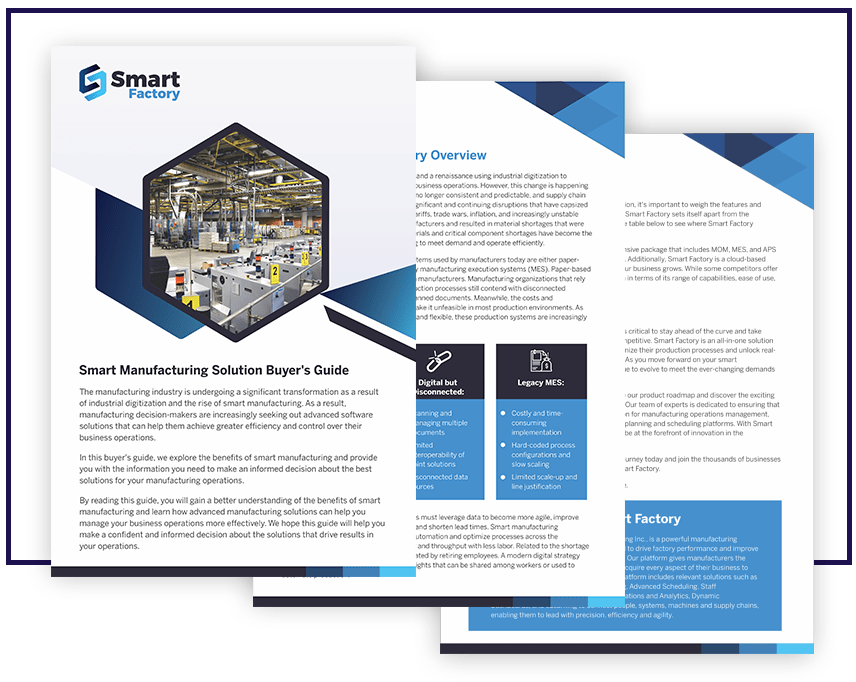
smart factory buyers guide

Ready to Optimize Workforce and Enhance Overall Productivity?

Maximize the potential of your workforce and streamline your production process with the Smart Factory Workforce Management module. Get complete control over your resources for better task scheduling, performance tracking, and more.

Workforce Management Metrics

Reduced labor costs

33%

Reduced labor costs

Increased productivity

20%

Increased productivity

Increased production output

30%

Increased production output

Reduced payroll errors

80%

Reduced payroll errors

Overcome Manufacturing Challenges with Workforce Management Software

one

Resource Scheduling

Workforce management module simplifies the employee shift scheduling process, making rapid changes and staff reassignments easy and efficient.

two

Accurate Attendance Tracking

The automated workforce system provides effective control over staff, ensuring accurate attendance tracking and payroll calculations.

three

Requirement Analysis

Identify workforce and resource needs based on production plans, availability, and skills. Compare demand with capacity to identify gaps, reduce overtime, and avoid unnecessary labor costs.

four

Real-Time Monitoring

Provides insights into real-time labor analytics and historical data, enabling the identification of areas for improvement related to the workforce.

five

Communication and Collaboration

No communication gap between staff and management, ensuring you don’t miss out on the information, such as shift and location changes, through notifications and messages.

Ready To See Smart Factory MOM in Action?

Transform your manufacturing business with Smart Factory MOM solutions. Request a demo to see Smart Factory MOM, a robust smart manufacturing software in action.

FAQs

Workforce management software is an automation tool designed to optimize resource allocation, ensuring the right people are in the right place and at the right time. It helps to manage employee schedules, track real-time productivity, predict future staffing needs with labor forecasting, boost efficiency, and reduce overall labor costs.

HR and workforce management software are both crucial in a company. However, they have distinct functions within an organization. HR management focuses primarily on recruitment, training, people management, and overall employee experience. On the other hand, a workforce management system focuses on operational efficiency, labor forecasting, managing workforce efficiently, time and attendance tracking, shift management, and labor cost management.

No, the workforce is not a CRM system. Both the software is different and have distinct functions. A workforce management system is primarily used for internal operations, including staff management, attendance and time tracking, and optimizing staff scheduling to prevent overstaffing and staff shortages. A CRM (Customer Relationship Management) system primarily focuses on external operations and communications, as well as customer interactions and relationship management. It includes marketing campaigns, sales automation, contact management to manage leads and opportunities, and more.

Workforce management software implementation could take one to six months. This duration depends on the company’s needs and requirements. Complex requirements could take a longer duration, and companies with simpler workflows can complete the implementation process within a few weeks.

Yes, a comprehensive workforce management solution provides labor forecasting. It helps predict future staffing needs, preventing overstaffing, and overtime among personnel in a company. Labor forecasting helps optimize schedules based on labor needs, availability, skills, and historical data, thereby minimizing overall labor costs.

Smart Factory
Privacy Overview

This website uses cookies so that we can provide you with the best user experience possible. Cookie information is stored in your browser and performs functions such as recognising you when you return to our website and helping our team to understand which sections of the website you find most interesting and useful.